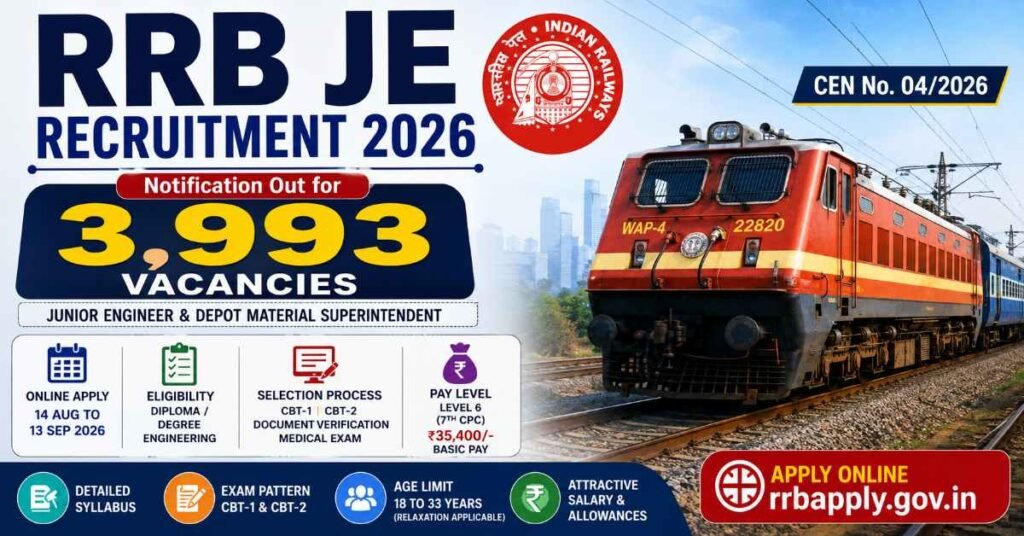
The Railway Recruitment Boards (RRBs) under the Ministry of Railways, Government of India, have officially issued the Centralised Employment Notice (CEN No. 04/2026) for the RRB JE Recruitment 2026. This recruitment drive opens 3,993 vacancies across technical engineering departments in 21 Railway Zones nationwide. The available roles encompass Junior Engineer (JE) across various technical streams and Depot Material Superintendent (DMS).
State Bank of India Junior Associate Recruitment 2026: 9,124 Vacancies, Eligibility & Exam Dates
Table of Contents
ToggleOnline applications opened on 14 August 2026 and will close on 13 September 2026 (23:59 hours).
RRB JE Recruitment 2026: Key Overview
| Attribute | Details |
|---|---|
| Exam Conducting Organization | Railway Recruitment Boards (RRBs), Ministry of Railways, Govt. of India |
| Employment Notice Number | CEN No. 04/2026 |
| Recruitment Name | RRB Junior Engineer (JE) Recruitment 2026 |
| Posts Offered | Junior Engineer (JE) & Depot Material Superintendent (DMS) |
| Total Available Vacancies | 3,993 Posts |
| Pay Matrix Level | Level 6 (7th Central Pay Commission) |
| Initial Basic Pay | ₹35,400/- per month + DA, HRA, Transport & Medical Allowances |
| Job Location | Across 21 Railway Zones & Production Units in India |
| Application Process Mode | Online Only |
| Selection Methodology | CBT-1 (Screening) \rightarrow CBT-2 (Technical Core) \rightarrow Document Verification \rightarrow Medical Exam |
| Official Application Web Portal | rrbapply.gov.in / indianrailways.gov.in |
Gujarat Police Lokrakshak DV List 2026 Released: Check Cut-Off & Merit List
Important Dates & Exam Schedule
| Recruitment Event | Official Schedule |
|---|---|
| Release of Detailed Notification (CEN 04/2026) | 13 August 2026 |
| Commencement of Online Application Submission | 14 August 2026 |
| Final Deadline for Online Application Form | 13 September 2026 (23:59 Hrs) |
| Last Date for Online Application Fee Payment | 15 September 2026 (23:59 Hrs) |
| Application Correction / Modification Window | 16 September 2026 to 25 September 2026 |
| Stage-1 Computer Based Test (CBT-1) | To Be Announced |
| Stage-2 Computer Based Test (CBT-2) | To Be Announced |
| Document Verification & Medical Examination | To Be Announced |
Post-Wise Vacancy Breakup & Departmental Distribution
The 3,993 positions announced under the RRB JE Recruitment are distributed among 21 participating Railway Recruitment Boards:
- Junior Engineer (Civil & Allied Engineering): Permanent Way (P-Way), Works, Bridge, Track Machine, Design & Drawing.
- Junior Engineer (Mechanical & Allied Engineering): Carriage & Wagon (C&W), Diesel Mechanical, Workshop, Loco, Mechanical Power, Production.
- Junior Engineer (Electrical & Allied Engineering): General Services (GS), Traction Distribution (TRD), Traction Rolling Stock (TRS), Traction Operation, EMU/MEMU.
- Junior Engineer (Electronics, Signal & Telecommunication): Signal, Telecommunication, Microwave, Wireless Systems.
- Depot Material Superintendent (DMS): Stores Department inventory, logistics, and material handling.
Eligibility Criteria for RRB JE Recruitment 2026
1. Age Limit (Calculated as on 01 January 2027)
- Minimum Age: 18 Years
- Maximum Age: 33 Years (for Unreserved / General category candidates)
Upper Age Relaxation Policy
- OBC (Non-Creamy Layer): 3 Years (Up to 36 years)
- SC / ST Candidates: 5 Years (Up to 38 years)
- PwBD (Unreserved/EWS): 10 Years (Up to 43 years)
- PwBD (OBC-NCL): 13 Years (Up to 46 years)
- PwBD (SC/ST): 15 Years (Up to 48 years)
- Ex-Servicemen: Length of defense service rendered + 3 years (plus community relaxation)
2. Educational & Technical Qualifications
Candidates must possess either a Three-Year Diploma or a Four-Year Degree (B.E. / B.Tech / B.Sc. Engineering) from an AICTE/UGC recognized university or board in the relevant discipline:
- Civil & Allied Engineering: Three-Year Diploma or B.E./B.Tech in Civil Engineering, Construction Technology, Structural Engineering, or relevant sub-streams.
- Mechanical & Allied Engineering: Three-Year Diploma or B.E./B.Tech in Mechanical, Production, Automobile, Manufacturing, Mechatronics, Industrial, Machining Engineering, or relevant sub-streams.
- Electrical & Allied Engineering: Three-Year Diploma or B.E./B.Tech in Electrical Engineering, Electrical & Electronics, Power Systems, or combined sub-streams.
- Electronics & Allied Engineering: Three-Year Diploma or B.E./B.Tech in Electronics, Electronics & Communication, Telecommunication, Instrumentation & Control, Computer Science, Computer Engineering, or Information Technology.
- Depot Material Superintendent (DMS): Three-Year Diploma or B.E./B.Tech in Any Engineering Discipline from a recognized university or board.
Note: Candidates appearing in their final year/semester exams whose results are not published by the closing date (13 September 2026) are not eligible to apply.
GSSSB Sanitary Inspector Recruitment 2026: 22 Vacancies, Apply Online
Application Fee & Refund Mechanism
The Indian Railways uses a partial fee refund system for applicants who appear in the Stage-1 CBT:
- General / OBC / EWS (Male): ₹500/- application fee. A refund of ₹400/- (deducting bank transaction charges) is credited upon appearing in CBT-1. Net fee: ₹100/-.
- SC / ST / Ex-Servicemen / Female / Transgender / Minorities / EBC / PwBD: ₹250/- application fee. A full refund of ₹250/- (minus bank charges) is credited upon appearing in CBT-1. Net fee: ₹0/-.
Payments must be made online through Internet Banking, Debit/Credit Card, or UPI on the official application portal.
Selection Process Breakdown
The selection process for RRB JE Recruitment is conducted through four sequential stages:
- Stage 1 — CBT-1 (Screening Test): Computer Based Test comprising 100 questions of 100 marks with a duration of 90 minutes. Candidates are shortlisted for CBT-2 at a ratio of approximately 1:15 per category.
- Stage 2 — CBT-2 (Technical Core Examination): Comprehensive test consisting of 150 questions of 150 marks with a duration of 120 minutes. Final merit ranking is prepared strictly based on the normalized marks obtained in CBT-2.
- Stage 3 — Document Verification (DV): Verification of original educational certificates, category credentials, and candidate identity.
- Stage 4 — Comprehensive Medical Examination (ME): Mandatory assessment by Railway Medical Authorities as per standard visual parameters (A-3, B-1, B-2, or C-1).
RRB JE Exam Pattern: CBT-1 & CBT-2
Stage 1: Computer Based Test (CBT-1) — Screening Test
- Nature: Qualifying screening test to shortlist candidates for Stage 2.
- Duration: 90 Minutes (120 Minutes for eligible PwBD candidates with scribes).
- Question Format: Multiple Choice Objective Type (100 Questions, 1 mark each).
- Negative Marking: 1/3 mark deducted for every incorrect response.
- Shortlisting Ratio: Approximately 15 times the category-wise vacancy total.
CBT-1 Section-Wise Question Distribution
- Mathematics: 30 Questions (30 Marks)
- General Intelligence & Reasoning: 25 Questions (25 Marks)
- General Science (Physics, Chemistry, Life Sciences up to 10th CBSE): 30 Questions (30 Marks)
- General Awareness: 15 Questions (15 Marks)
- Total: 100 Questions, 100 Marks, 90 Minutes composite time
Stage 2: Computer Based Test (CBT-2) — Merit Determining Stage
- Nature: Final merit ranking is prepared based on the normalized marks obtained in CBT-2.
- Duration: 120 Minutes (160 Minutes for eligible PwBD candidates with scribes).
- Question Format: 150 Multiple Choice Questions (1 mark each).
- Negative Marking: 1/3 mark deducted for every wrong attempt.
CBT-2 Section-Wise Question Distribution
- General Awareness: 15 Questions (15 Marks)
- Physics & Chemistry (10th Standard CBSE Level): 15 Questions (15 Marks)
- Basics of Computers and Applications: 10 Questions (10 Marks)
- Basics of Environment and Pollution Control: 10 Questions (10 Marks)
- Technical Abilities (Core Engineering Discipline): 100 Questions (100 Marks)
- Total: 150 Questions, 150 Marks, 120 Minutes composite time
Detailed Topic-Wise Syllabus for RRB JE 2026
CBT-1 Detailed Syllabus
- Mathematics (30 Marks): Number Systems (Rational/Irrational numbers, BODMAS, Decimals, Fractions, LCM and HCF), Arithmetic Operations (Ratio and Proportion, Percentages, Mensuration 2D & 3D, Time and Work, Time and Distance, Pipes and Cisterns), Commercial Mathematics (Simple and Compound Interest, Profit and Loss, Discount), Advanced Algebra & Geometry (Basic algebraic identities, linear equations, polynomials, lines, angles, triangles, circles, polygons), and Trigonometry & Statistics (Trigonometric ratios, heights and distances, Mean, Median, Mode, Standard Deviation, Square Root, Calendar & Clock).
- General Intelligence & Reasoning (25 Marks): Verbal Reasoning (Analogies, Alphabetical and Number Series, Coding-Decoding, Mathematical Operations, Blood Relations, Syllogism, Jumbling), Analytical Reasoning (Venn Diagrams, Data Interpretation and Sufficiency, Conclusions and Decision Making, Statement-Arguments, Statement-Assumptions), and Non-Verbal Reasoning (Similarities and Differences, Spatial Orientation, Direction Sense Test, Classification, Matrix, Figural Patterns).
- General Science (30 Marks): Physics (Kinematics, Laws of Motion, Work, Energy and Power, Gravitation, Sound, Light, Electricity, Magnetism), Chemistry (Structure of Atom, Periodic Classification, Chemical Reactions & Equations, Acids, Bases & Salts, Metals and Non-Metals, Carbon & its Compounds), and Life Sciences (Cell biology, Human organ systems, Genetics, Plant physiology, Diseases, Nutrition).
- General Awareness (15 Marks): Current affairs (National and International events), Indian Geography, Indian History and Freedom Struggle, Indian Polity and Constitution, Indian Economy and Union Budget, Scientific and Technological Innovations, Indian Space Programs, Defense, Sports, and Honors.
CBT-2 Detailed Syllabus
Common Non-Technical Subjects (50 Marks)
- General Awareness (15 Marks): Advanced current affairs, railway budgeting, national infrastructure projects, economic developments, and international summits.
- Physics & Chemistry (15 Marks): Conceptual, numerical, and application-oriented problems rooted in 10th CBSE science framework.
- Basics of Computers and Applications (10 Marks): Computer architecture, CPU, primary and secondary memory devices, Input/Output hardware, Operating Systems (Windows, Unix, Linux), MS Office (Word, Excel, PowerPoint), binary and hexadecimal representation, computer networking fundamentals, Internet protocols, email systems, and cybersecurity concepts.
- Basics of Environment and Pollution Control (10 Marks): Ecosystem dynamics, ecological balance, air, water, soil, and noise pollution control, solid waste management, hazardous waste handling, ozone layer depletion, acid rain, global warming, greenhouse gases, international climate protocols, environmental protection acts, and eco-friendly railway initiatives.
CBT-2 Technical Engineering Syllabus (100 Marks)
- Civil & Allied Engineering: Engineering Mechanics & Structural Analysis (Equilibrium of forces, friction, centroids, moment of inertia, SFD/BMD for determinate structures, deflection of beams, truss analysis), Building Materials & Construction (Cement, aggregates, lime, bricks, timber, masonry, foundations), Concrete Technology (Mix design, water-cement ratio, workability, curing, admixtures, prestressed concrete), Surveying (Linear measurements, chain, compass, plane table, leveling, contouring, theodolite, tacheometry, total station), Geotechnical Engineering (Soil classification, permeability, shear strength, compaction, consolidation, bearing capacity), Hydraulics & Water Resources (Fluid properties, Bernoulli’s equations, pipe and channel flow, hydraulic jumps, hydrology cycle, runoff), Design of Structures (RCC and Steel limit state design, beams, slabs, columns, footings, welded/bolted connections).
- Mechanical & Allied Engineering: Engineering Mechanics & Strength of Materials (Free body diagrams, simple stress and strain, thermal stresses, bending and shear stresses, torsion, thin-walled vessels), Theory of Machines & Machine Design (Mechanisms, flywheels, governors, gear trains, shafts, keys, couplings, joints), Thermal Engineering & Thermodynamics (Laws of Thermodynamics, entropy, power cycles like Carnot, Otto, Diesel, Rankine, Brayton, IC engines, boilers, steam nozzles, condensers, refrigeration and air conditioning), Fluid Mechanics & Hydraulic Machines (Fluid statics/dynamics, Bernoulli’s equation, boundary layer, Pelton wheel, Francis and Kaplan turbines, pumps), Material Science & Production Engineering (Iron-carbon diagram, heat treatment, casting, forging, rolling, extrusion, TIG/MIG welding, machining, CNC fundamentals, metrology, limits, fits, tolerances), Industrial Management (Plant layout, inventory control EOQ/ABC, work study, CPM/PERT).
- Electrical & Allied Engineering: Basic Concepts & DC Circuits (Resistance, inductance, capacitance, Ohm’s law, KCL/KVL, Thevenin’s, Norton’s, Superposition, Maximum Power Transfer theorems), AC Fundamentals & Magnetic Circuits (AC waveforms, RMS, phasor representation, RLC series and parallel circuits, resonance, three-phase star/delta, magnetic flux, hysteresis, eddy currents), Electrical Machines (DC machines, single-phase and three-phase transformers, induction motors, synchronous alternators/motors), Power Systems (Generation, transmission line parameters, sag calculation, insulators, cables, substations, power factor improvement), Switchgear, Protection & Measurements (Circuit breakers, protective relays, grounding, measuring instruments, bridges), Basic Electronics & Power Electronics (Diodes, BJTs, JFETs, MOSFETs, Op-Amps, SCR, DIAC, TRIAC, inverters, choppers).
- Electronics & Allied Engineering: Electronic Devices & Analog Circuits (PN diodes, Zener diodes, BJTs, FETs, small-signal models, multistage amplifiers, feedback amplifiers, oscillators, Op-Amps), Digital Electronics (Number systems, Boolean algebra, logic gates, K-maps, combinational logic, sequential circuits, ADC/DAC, semiconductor memories), Microprocessors & Microcontrollers (8085/8086 architectures, instruction sets, interrupts, 8051 microcontrollers, peripheral interfacing), Communication Engineering (AM, FM, PM, digital modulation ASK/FSK/PSK/QAM, sampling theorem, PCM, TDM/FDM, antennas, wave propagation, optical fiber, microwave links), Electronic Instruments & Measurement (CRO, DSO, spectrum analyzers, transducers, telemetry systems).
Mehsana Urban Co-operative Bank Recruitment 2026: 3 AGM Posts, Eligibility & Apply Online
Zone-Wise Participating RRBs
Candidates may apply to only one Railway Recruitment Board (RRB) across the country:
- RRB Ahmedabad:
rrbahmedabad.gov.in - RRB Ajmer:
rrbajmer.gov.in - RRB Prayagraj (Allahabad):
rrbald.gov.in - RRB Bangalore:
rrbbnc.gov.in - RRB Bhopal:
rrbbpl.nic.in - RRB Bhubaneswar:
rrbbbs.gov.in - RRB Bilaspur:
rrbbilaspur.gov.in - RRB Chandigarh:
rrbcdg.gov.in - RRB Chennai:
rrbchennai.gov.in - RRB Gorakhpur:
rrbgkp.gov.in - RRB Guwahati:
rrbguwahati.gov.in - RRB Jammu-Srinagar:
rrbjammu.nic.in - RRB Kolkata:
rrbkolkata.gov.in - RRB Malda:
rrbmalda.gov.in - RRB Mumbai:
rrbmumbai.gov.in - RRB Muzaffarpur:
rrbmuzaffarpur.gov.in - RRB Patna:
rrbpatna.gov.in - RRB Ranchi:
rrbranchi.gov.in - RRB Secunderabad:
rrbsecunderabad.nic.in - RRB Siliguri:
rrbsiliguri.gov.in - RRB Thiruvananthapuram:
rrbthiruvananthapuram.gov.in
| Resource / Link Description | Direct Link / Action |
|---|---|
| Official Notification PDF | Download |
| Apply Online Portal | Click Here |
| Official Website | Visit Now |
| WhatsApp Channel | Follow Now |
| Telegram Channel | Follow Now |
| Instagram Page | Follow Now |
| Home Page | Visit Now |
Step-by-Step Guide: How to Apply Online for RRB JE Recruitment 2026
- Account Creation & Registration: Visit
rrbapply.gov.in, click on “Apply”, select “Create an Account”, and enter basic identification details including active email ID and mobile number to receive OTPs for login generation. - Selecting RRB & Filling Personal Details: Log in with your credentials, select your preferred RRB Zone, and provide community details (UR/OBC/SC/ST/EWS), nationality, and Aadhaar information.
- Entering Educational & Technical Qualifications: Enter matriculation (10th) information and engineering Diploma or Degree details along with your appropriate Exam Group.
- Setting Post Preferences: Review eligible posts matching your qualification and assign sequential preference numbers (1, 2, 3…) for the selected RRB zone.
- Document Uploading Specifications: Upload a recent color photograph with a white background (30 KB to 70 KB, JPEG), a clear running-hand signature in blue/black ink (30 KB to 70 KB, JPEG), and SC/ST community certificate in PDF format (50 KB to 300 KB) if opting for a free travel pass.
- Fee Payment & Final Submission: Verify all details in the preview window, complete the online fee transaction, and save a physical copy of the submitted confirmation page.
Kamdhenu University Junior Clerk Call Letter 2026: Direct Download Link & Exam Rules
Medical Standards & Visual Fitness Requirements
- Medical Standard A-3: Physically fit in all respects. Distant vision of 6/9, 6/9 with or without glasses (lens power not exceeding 2D). Near vision Sn: 0.6, 0.6 with or without glasses. Must pass tests for Color Vision, Binocular Vision, Field of Vision, and Night Vision.
- Medical Standard B-1: Physically fit in all respects. Distant vision of 6/9, 6/12 with or without glasses (lens power not exceeding 4D). Near vision Sn: 0.6, 0.6 with or without glasses. Must pass tests for Color Vision, Binocular Vision, Field of Vision, and Night Vision.
- Medical Standard B-2: Physically fit in all respects. Distant vision of 6/9, 6/12 with or without glasses (lens power not exceeding 4D). Near vision Sn: 0.6, 0.6 with or without glasses. Must pass tests for Field of Vision and Binocular Vision.
- Medical Standard C-1: Physically fit in all respects. Distant vision of 6/12, 6/18 with or without glasses. Near vision Sn: 0.6, 0.6 with or without glasses. No mandatory tests for color or field vision.
Salary Structure, Perks & Allowances
- Pay Matrix Level: Level 6 (7th CPC)
- Initial Basic Pay: ₹35,400/- per month
- Dearness Allowance (DA): Periodically revised central government rates.
- House Rent Allowance (HRA): 30% for Class X cities, 20% for Class Y cities, and 10% for Class Z cities.
- Transport Allowance (TPTA): ₹3,600/- + applicable DA in major cities.
- Additional Benefits: Complimentary Railway Passes, subsidized medical care in Railway Hospitals, government residential quarters, Night Duty Allowances, and National Holiday Allowances.
- Gross Monthly Salary: Typically ranges from ₹54,000/- to ₹65,000/- per month at entry level depending on the posting station.
Strategic Preparation Blueprint for RRB JE 2026
- Mathematics: Practice mental arithmetic and NCERT formulas for algebra and trigonometry daily.
- General Science: Study NCERT Science textbooks from Class 8 to Class 10 with a focus on circuits, mechanics, chemical equations, and human physiology.
- Reasoning: Solve 30–40 diverse analytical and logical puzzles daily under timed conditions.
- Mock Tests: Attempt 2 full-length CBT-1 mock tests per week within the 90-minute limit.
- Technical Focus (CBT-2): Consolidate core engineering fundamentals and maintain concise revision formula sheets.
- Basics of Computers & Environment: Prepare computer hardware, networking basics, MS Office shortcuts, and environmental pollution laws to secure high scores in this 20-mark combined segment.
- Previous Year Papers: Solve past 10 years’ questions from RRB JE, SSC JE, and state engineering exams to recognize recurring conceptual patterns.
Frequently Asked Questions (FAQs)
Q1: Can final-year engineering students apply for RRB JE Recruitment 2026? No. Candidates must possess their final degree/diploma passing certificates or provisional degree on or before the closing date for online applications (13 September 2026).
Q2: Is there negative marking in RRB JE CBT-1 and CBT-2? Yes. In both stages, 1/3 mark is deducted for every incorrect answer. Unattempted questions carry no penalty.
Q3: Are marks obtained in CBT-1 counted toward the final selection list? No. CBT-1 is purely a qualifying screening test. The final merit empanelment is prepared based entirely on the normalized marks scored in CBT-2, subject to clearing Document Verification and the Medical Exam.
Q4: Can a candidate apply to more than one RRB zone? No. Applying to multiple RRBs is strictly prohibited. Submitting multiple applications across different boards will lead to rejection of all applications.
Q5: What is the minimum qualifying score for different categories? The standard minimum qualifying percentage for both CBT-1 and CBT-2 is 40% for UR/EWS, 30% for OBC (Non-Creamy Layer), 30% for SC, and 25% for ST candidates.
The RRB JE Recruitment 2026 provides an avenue to join the Indian Railways as a technical supervisor. Candidates should ensure all eligibility criteria are satisfied and complete their registrations before the deadline at rrbapply.gov.in.